Solid Wood Doors at S$75. Here's What That Actually Means in Singapore.
Who this is for
Most shoe cabinets under S$100 are melamine-faced particleboard with screw-on handles and sharp corners. You know the type — flat-pack, flat-pack, flat-pack. The doors warp within 18 months. The handles loosen. The edges chip. The bottom shelf swells from wet shoes because the edge banding was an afterthought.
This cabinet is different. And the difference isn't marketing — it's visible in the grain of the wood, the curve of the feet, the recess of the handle, and the radius of every edge.
We opened the doors. We ran our hands across the surfaces. We looked at how the feet meet the floor. Here's what we found.
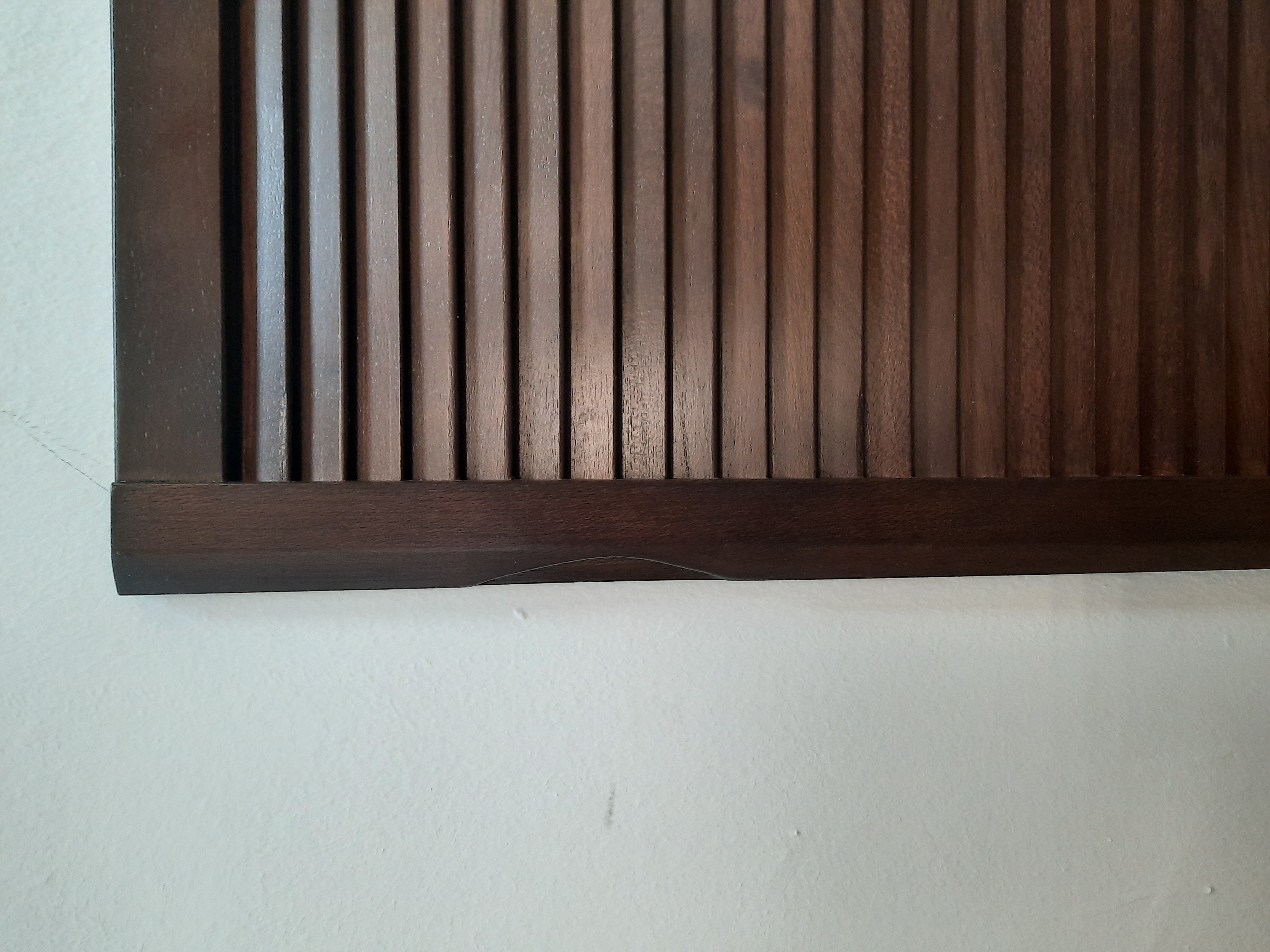
Solid wood doors — not particleboard with a wood-print sticker
Open the door of this cabinet and look at the grain. It runs continuously across the slat, through the stile, into the rail. That's solid wood. Not melamine. Not laminate. Not a photograph of wood glued onto MDF.
Solid wood matters in Singapore for one reason that most retailers won't tell you: humidity cycles.
Singapore sits at 70-85% relative humidity for most of the year. When the monsoon shifts, that number spikes. When the air-con runs, it drops. Wood expands when it absorbs moisture. It contracts when it dries. Particleboard handles this cycle by swelling at the edges — the exposed core absorbs moisture, the edge banding lifts, and within 12-18 months you've got a door that doesn't close flush.
Solid wood handles the same cycle differently. It moves — expands, contracts — but uniformly. The grain structure distributes the stress across the entire panel. There's no exposed core to absorb moisture. No edge banding to delaminate. The door stays a door.
The louvered slats are solid wood too. Each slat is individually shaped and set into the frame. That's not a pressed panel with a ventilation slot cut through it — it's wood, shaped to allow airflow while blocking direct sightlines into the cabinet. Air moves through. Shoes dry. Odours dissipate. Moisture doesn't pool.
Rounded feet — not a flat base sitting on the floor
Most budget shoe cabinets sit flat on the floor. The bottom panel touches the ground. Water from wet shoes, mopping residue, condensation from HDB corridor floors — it all sits against the base. The wood swells. The finish darkens. Within a year, the bottom edge shows water marks.
This cabinet has rounded wooden feet. The base is raised off the floor by approximately 20-30mm. That gap isn't decorative — it's a moisture barrier. Air circulates underneath. Water doesn't pool against the wood. The feet carry the load; the base stays dry.
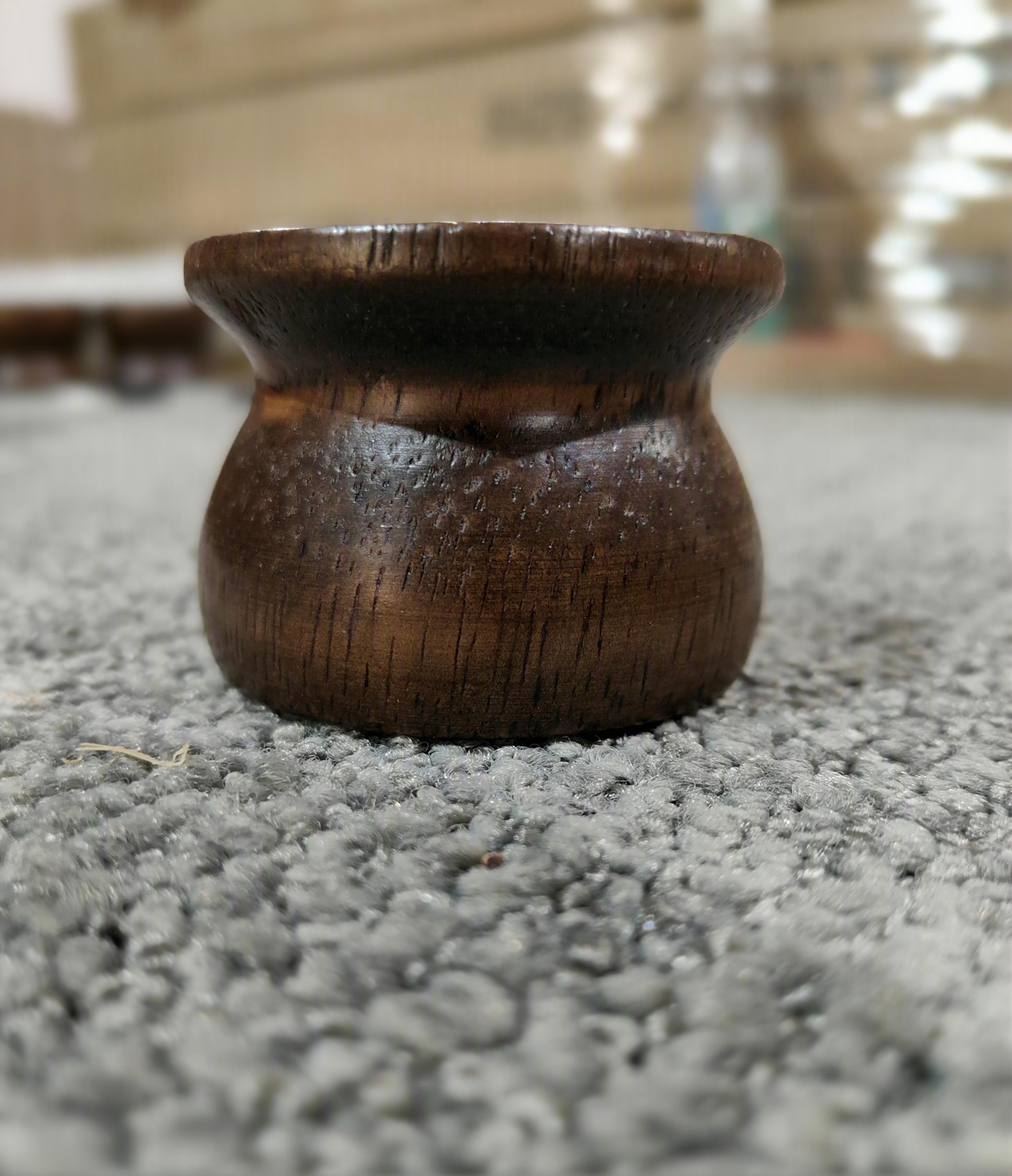
The feet are also rounded — not sharp, not angular. In an HDB entryway where kids run past, where shoes get kicked off, where bags get dropped, rounded feet mean no splinters, no gouges in the floor, no sharp corners catching on anything. Small detail. Real consequence.
Rounded edges on the top — because entryways aren't showrooms
The top panel has a radius on every edge. Not a sharp 90-degree corner. A smooth curve.
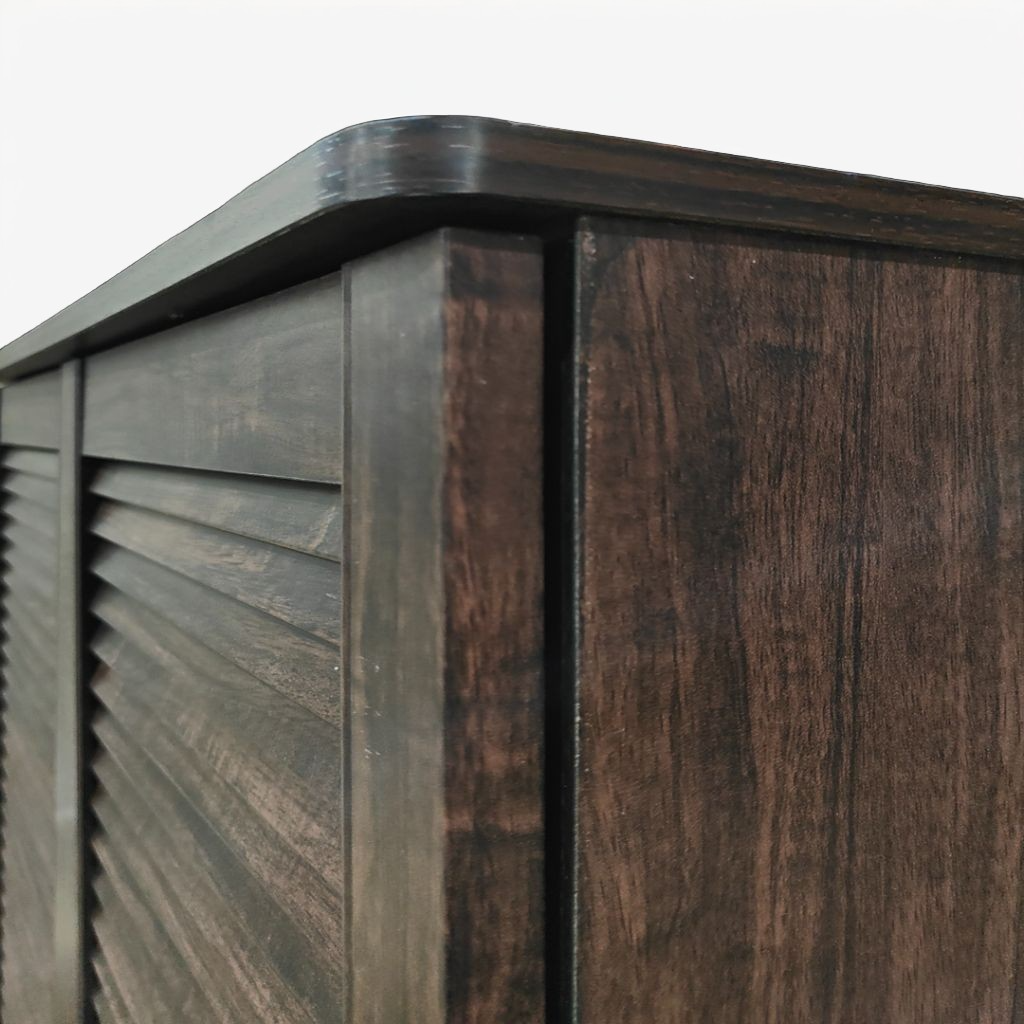
Run your hand along it. There's no point where the wood ends abruptly. No edge that catches on clothing. No corner that bruises a hip when you're reaching for shoes in a hurry.
In a showroom, sharp edges look clean. In an HDB corridor — where the cabinet sits against a wall, where people pass on both sides, where bags and coats get draped over it — sharp edges are a liability. They chip when bumped. They snag fabric. They hurt when you walk into them at 6am before the coffee kicks in.
The rounded top is also easier to clean. Dust doesn't collect in sharp corners. A damp cloth follows the curve. No crevice to dig into.
Recessed handles — no protruding hardware
The handles aren't screwed onto the door. They're carved into the frame. A recessed groove in the wood, shaped to accept your fingers, sitting flush with the door surface.
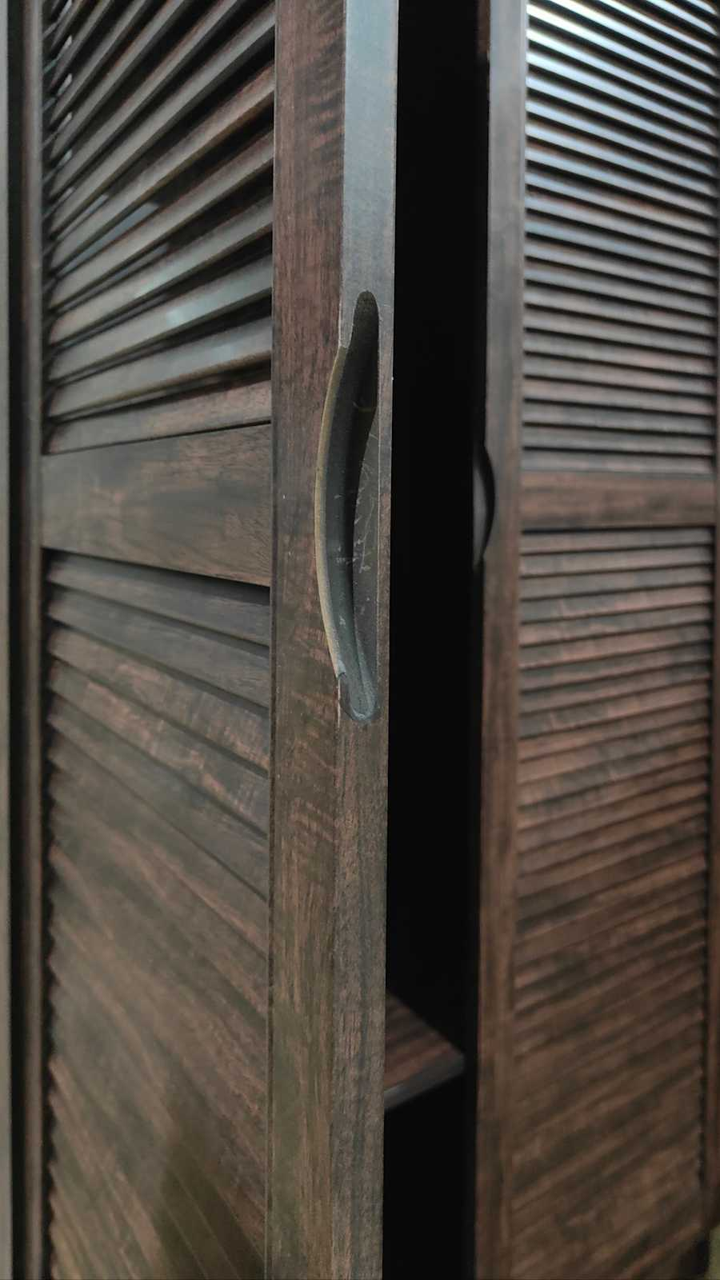
This matters for three reasons:
Durability: Protruding handles get bumped, caught, pulled. In a narrow HDB corridor, anything that sticks out from the cabinet face is a target. Recessed handles can't be knocked off because there's nothing to knock.
Cleaning: No handle hardware means no crevice where dust collects. No screws to tighten. No finish to wear off around the grip point.
Space: A protruding handle adds 30-50mm to the cabinet's effective depth. In a corridor that's 900mm wide, and a cabinet that's 380mm deep, you've only got 520mm of walking space. Subtract 40mm for a handle and you're at 480mm — tight for anyone carrying groceries.
Recessed handles keep the cabinet at its actual 380mm depth. The corridor stays passable.
750mm × 985mm × 380mm — the HDB entryway math
Here's where the dimensions matter:
750mm wide: Standard HDB corridor width is 900-1,000mm. A 750mm cabinet leaves 150-250mm on either side — enough for a person to pass, but tight with bags. Place it against the wall at the entryway, not in the corridor. Most HDB entryways have a recessed area beside the door — this cabinet fits there.
985mm tall: Standard HDB window sill height is 900mm. This cabinet is 85mm above the sill. If you're placing it near a window, measure first. If the window opens outward, the cabinet may block the swing. If the window opens inward, you're fine.
380mm deep: This is the critical number. A standard HDB corridor is 900mm wide. Subtract 380mm for the cabinet and you've got 520mm of walking space. That's enough for one person. Two people passing each other — one will need to step aside. If your corridor is narrower than 900mm, measure before you buy.
The sweet spot for this cabinet is the entryway alcove — the recessed space beside the main door where shoes naturally accumulate. Most HDB 3-room and 4-room flats have this alcove. The cabinet fills it without encroaching on the corridor.
Why this cabinet is clearance
This is defensive procurement, not overstock.
A property management company was renovating HDB rental units. Each unit needed entryway storage. They ordered a batch of shoe cabinets — this model among them. We held backup units in case of transit damage or specification mismatches during installation.
All units installed without issue. The backups sat in our warehouse. Contract ended. Spares released to clearance.
That's why this cabinet is S$75 instead of S$127. Not because anything is wrong with it. Because nothing went wrong with the order it was part of.
The warehouse math:
| What | Cost |
|---|---|
| Wholesale cost per unit | S$52 |
| Warehouse holding (6 months × S$1.50/unit/month) | S$9 |
| Total cost to us | S$61 |
| Clearance price | S$75 |
| Recovery margin | S$14 |
That S$14 covers handling, photography, listing, and the admin time of writing this article. The property manager got their units at contract price. You're getting backup stock at 41% off.
What to check before you buy
Clearance. Final sale. No returns unless defective. Here's what to inspect.
Door grain — verify solid wood
Open both doors. Look at the grain on the inner face. It should be continuous — no seam where a veneer was applied, no pattern repetition that indicates a printed surface. Solid wood grain is irregular. That irregularity is the proof.
Slat alignment — check the louvers
The horizontal slats should be evenly spaced and parallel. Run your finger across them. They should feel consistent — same spacing, same angle, same depth. If one slat is higher or lower than its neighbours, the frame may have shifted during storage. Minor — but worth checking.
Feet stability — press the corners
Press down on each corner of the cabinet. It should sit flat. No rocking. No wobble. If one foot is shorter than the others, the base panel may have warped. This shouldn't happen with solid wood construction, but verify.
Handle recess — check for splinters
Run your fingers through the recessed handle groove. It should feel smooth — no splinters, no rough edges, no finish gaps. The recess is carved, not assembled. Any roughness here means the finish was rushed.
Top edge — feel the radius
Run your palm along the top edge. The curve should be consistent across the entire length. No flat spots. No sharp transitions. The radius is a construction choice — if it's inconsistent, the cabinet wasn't finished to the standard it was built to.
Who this cabinet is for
HDB entryway owners: Your corridor collects shoes. A closed cabinet hides them. Solid wood doors resist the humidity that wrecks cheaper cabinets. The louvered slats let wet shoes dry without trapping odour.
Families with young children: Rounded edges and recessed handles mean no sharp corners at hip height, no protruding hardware to catch on clothing or skin. The raised feet mean the base doesn't sit in whatever water tracks in from the corridor.
Anyone replacing a flat-pack shoe cabinet: If your current cabinet's doors don't close flush, the edge banding is lifting, or the handles are loose — this is what happens when the material spec is wrong for Singapore's climate. Solid wood handles the cycle differently.
Landlords furnishing rental units: Solid wood at this price point is unusual. For multiple units, the durability advantage compounds — less maintenance, fewer replacements, no tenant complaints about swelling doors or broken handles.
This is a clearance item. What that means:
- 1 year warranty on structural defects (frame, doors, feet, surface)
- Delivery included
- Final sale — no returns unless defective on delivery
- Same build quality as the units in the property management contract
Not sure if this fits your entryway? Use our Residential Spatial Guide to check the dimensions before you buy.
Related reading: We Measured a Wardrobe Ourselves. Here's What the Spec Sheet Hides. — how solid wood construction and accurate dimensions matter for Singapore's humidity cycles.
Want to see all clearance? /clearance
Skip reading if you must (we like you understand) — quick clicks are fine, no need to fuss — but do not miss completing your purchase. Once it's gone, it's gone.
Related investigations
Further reading from the catalog
You Don't Need a Bigger Shoe Cabinet. You Need Another One.
Every HDB household hits the same wall: the shoe cabinet is full. Six months after moving in, someone's work boots are permanently parked beside it. Another...
Read article →We Measured a Wardrobe Ourselves. Here's What the Spec Sheet Hides.
We put a tape measure to this wardrobe. Not someone else's numbers. Ours. Front. Side. Back. Interior. Every panel. Every gap. The kind of measurement you'd...
Read article →200 Students, 40 Chairs, 3 Academic Years: What School Furniture Contracts Reveal
I once delivered 40 training chairs to a secondary school in Tampines. Three months later the facilities manager called — not because anything broke, but...
Read article →Found an inaccuracy?